I've spent 7 years in Tucson, will be 8 before I leave, and I'm still learning some of the cultural differences between here and "back east"
Case in point: Nobody, except me, wears evening clothes (aka a tuxedo) to the symphony's opening night.
Neither way is clearly better, but one sure is strange to me!
Showing posts with label Tucson. Show all posts
Showing posts with label Tucson. Show all posts
Saturday, October 23, 2010

Tuesday, August 03, 2010
Why Sun Tran management and Tucson need to stand firm in negotiations with the Teamsters.
By now, readers have likely read or heard of the ongoing Sun Tran strike that has bus service in Tucson cut back to extremely limited service leaving many who cannot afford autos nearly stranded in a city designed and built for autos.
It's a severe inconvenience, and it lays bare the often forgotten "distributional" implications of transportation policy decisions. To many of the working poor, it's more than an inconvenience; it's like a kneecapping of their livelihood.
But the Teamsters are asking far, far too much for Sun Tran management. If necessary, strikebreakers should be hired to get the buses moving and the poor to their jobs ASAP. Caving in is not an option.
This is no mere dispute over wages and benefits: the union is demanding that there be no route cutbacks, no layoffs, and that Sun Tran be transferred to the sales-tax subsidized RTA. More than retirees and xenophobia have crossed the Colorado River in recent years. The Teamsters in this dispute are, like California government-employees' unions, attempting to arrogate to themselves the ability to set policy. Not in this state, not even in left-leaning Tucson, should they be allowed to do so.
It's a severe inconvenience, and it lays bare the often forgotten "distributional" implications of transportation policy decisions. To many of the working poor, it's more than an inconvenience; it's like a kneecapping of their livelihood.
But the Teamsters are asking far, far too much for Sun Tran management. If necessary, strikebreakers should be hired to get the buses moving and the poor to their jobs ASAP. Caving in is not an option.
This is no mere dispute over wages and benefits: the union is demanding that there be no route cutbacks, no layoffs, and that Sun Tran be transferred to the sales-tax subsidized RTA. More than retirees and xenophobia have crossed the Colorado River in recent years. The Teamsters in this dispute are, like California government-employees' unions, attempting to arrogate to themselves the ability to set policy. Not in this state, not even in left-leaning Tucson, should they be allowed to do so.
Saturday, July 24, 2010
Tim B. Lee, Honorary Tucsonist
Judging from his observations concerning the effects of freeway construction on St. Louis, Tim B. Lee would probably get along well in Tucson.
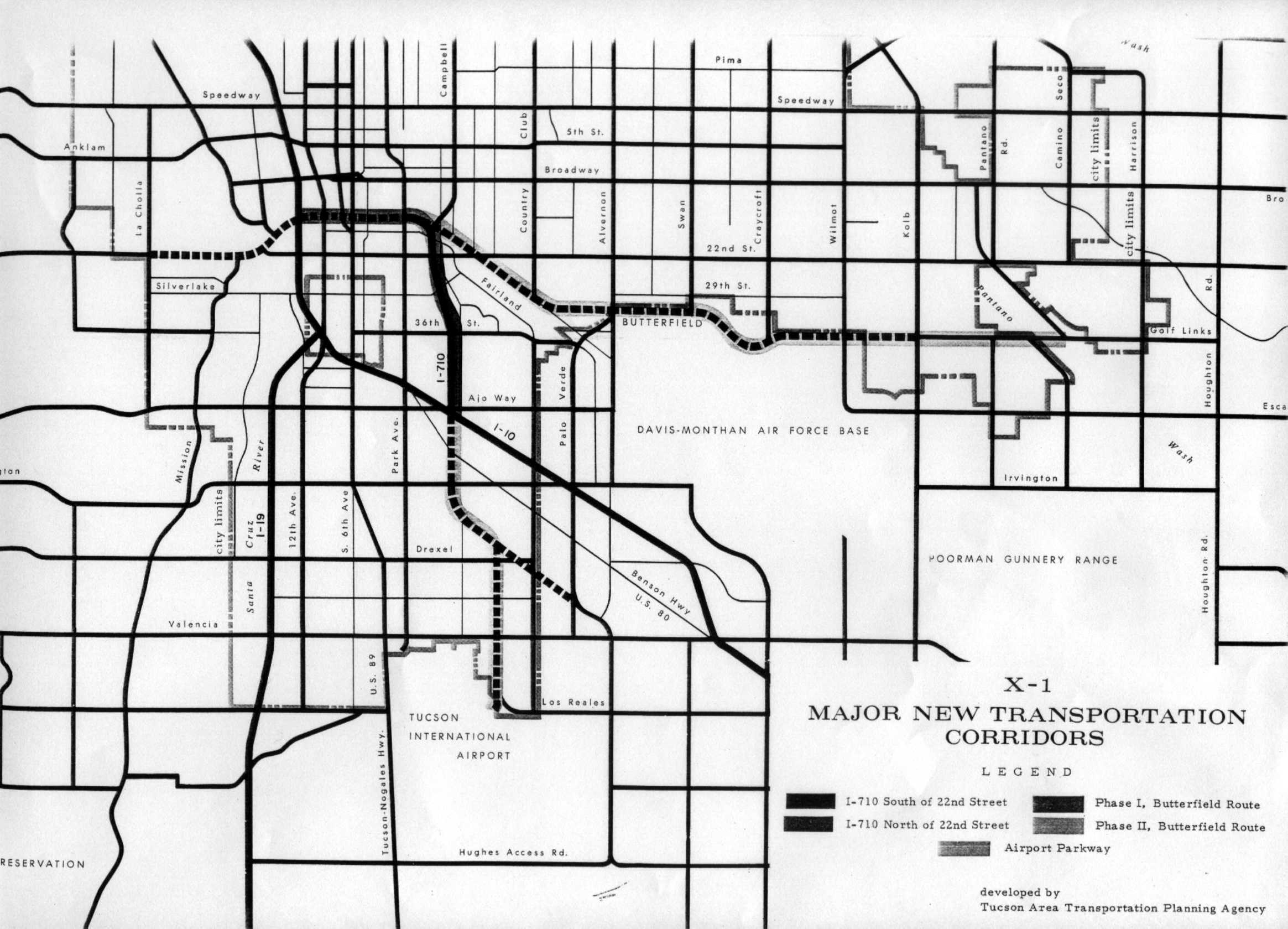
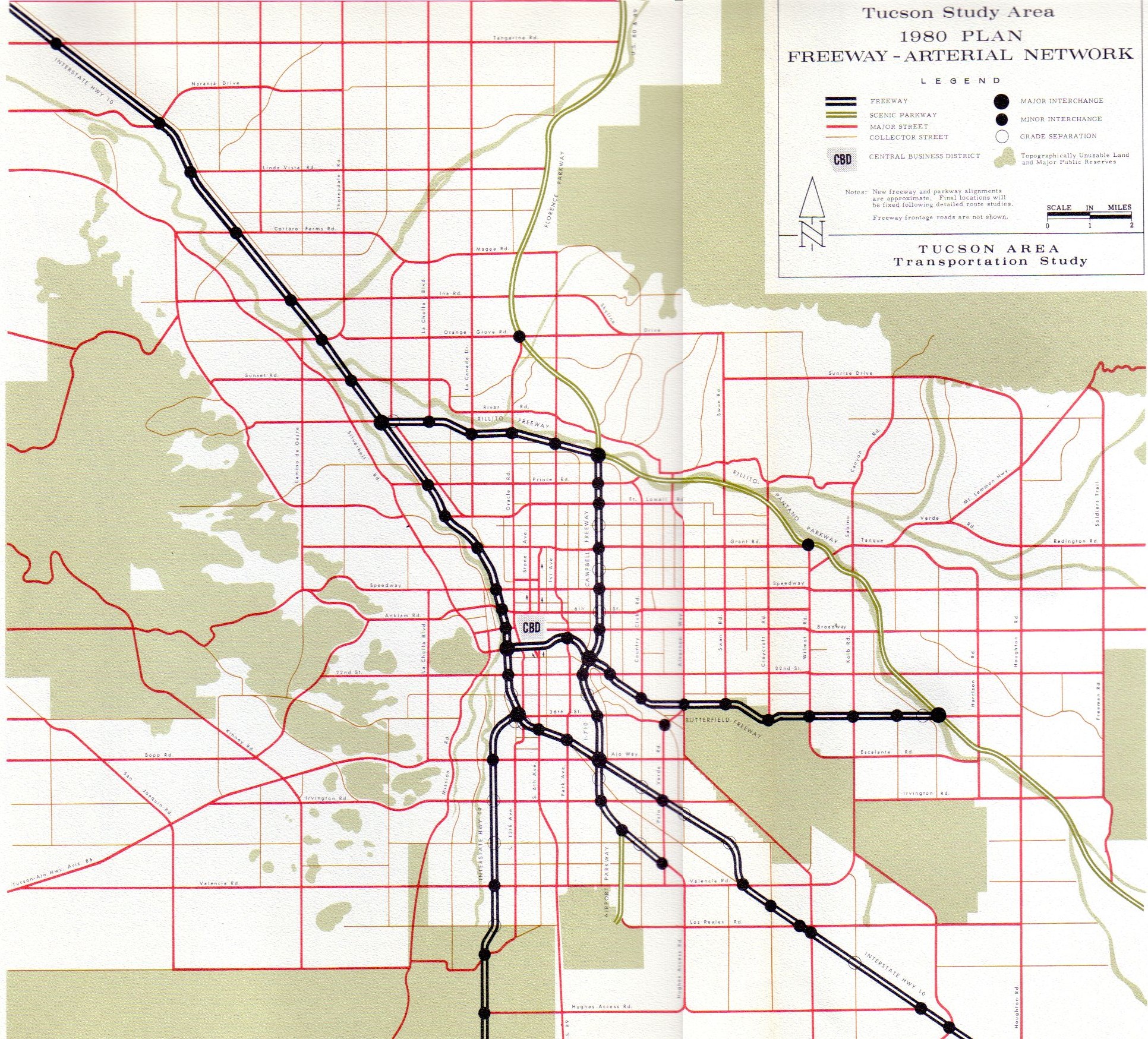
There used to be plans here, from 1958 into the 1970s, to to build an "I-710" freeway following the route of Campbell Avenue. Earlier versions of this scheme followed this by construction of a freeway over the bed of the Rillito.
Nowadays putting concrete and exhaust fumes over our greenbelts seems ridiculous, the stuff of self-discrediting old curmudgeons who've lost the part of their brain that makes it clear why such things are valuable. Tucsonans know in their gut that our resistance to building superhighways is what made and makes our city coherent, bikeable, walkable, and keeps our air free of smog despite our being caught between four mountain ranges. It may frustrate the newcomers, but we have no inclination to destroy neighborhoods for suburbanites' convenience in the way New Orleans, St. Louis, or Philadelphia did. If they wanted that, on their way in from Orange County they should have gotten off the I-10 about 120 miles earlier!
There used to be plans here, from 1958 into the 1970s, to to build an "I-710" freeway following the route of Campbell Avenue. Earlier versions of this scheme followed this by construction of a freeway over the bed of the Rillito.
Nowadays putting concrete and exhaust fumes over our greenbelts seems ridiculous, the stuff of self-discrediting old curmudgeons who've lost the part of their brain that makes it clear why such things are valuable. Tucsonans know in their gut that our resistance to building superhighways is what made and makes our city coherent, bikeable, walkable, and keeps our air free of smog despite our being caught between four mountain ranges. It may frustrate the newcomers, but we have no inclination to destroy neighborhoods for suburbanites' convenience in the way New Orleans, St. Louis, or Philadelphia did. If they wanted that, on their way in from Orange County they should have gotten off the I-10 about 120 miles earlier!
Thursday, April 29, 2010
The partition of Arizona
"Baja Arizona" has been tossed about for a while to describe Southern AZ. I'd like to think it the more sober portion of Arizona, the one that put solidly Goldwater Republican Jim Kolbe in the house for eleven terms.
A friend just coined a new complement to this: Phoenix and environs as "Loco Arizona". Not a bad label for the portion of the state populated by geriatric immigrants from places like Ohio, Indiana, and the Chicago suburbs who come here, grow green lawns, and get upset over rattlesnakes, "dry heat", and Mexicans of any citizenship.
Should there be an Arizonan divorce? The problem with Baja Arizona is that it isn't just Kolbe territory. (I'd bring up Giffords, but she caved on the community rating mandate/high deductible ban bill). It also sends far-leftist union stooge Grijalva to the House cycle after cycle. And it's home to the U of A, the "Salt of the Earth Labor College", and the geriatric folks from back east whose political opinions come straight out of 1935, market abolitionism and all. Baja Arizona is Soviet Snowbirdistan.
SB 1070 probably isn't the big deal the Soviet Snowbirdistan types are making of it--that'll depend on whether or not police departments elect to violate Constitutional standards in its enforcement. (That isn't a given.) And recall that the tension between Arizona's lunatics makes AZ the eighth most liberal state in the Union. Without Phoenix, we'd be Massachusetts. And perhaps without Tucson, we'd be everything the San Franciscans and media whores are currently imagining we are.
But I do like "Loco Arizona". That should stick.
A friend just coined a new complement to this: Phoenix and environs as "Loco Arizona". Not a bad label for the portion of the state populated by geriatric immigrants from places like Ohio, Indiana, and the Chicago suburbs who come here, grow green lawns, and get upset over rattlesnakes, "dry heat", and Mexicans of any citizenship.
Should there be an Arizonan divorce? The problem with Baja Arizona is that it isn't just Kolbe territory. (I'd bring up Giffords, but she caved on the community rating mandate/high deductible ban bill). It also sends far-leftist union stooge Grijalva to the House cycle after cycle. And it's home to the U of A, the "Salt of the Earth Labor College", and the geriatric folks from back east whose political opinions come straight out of 1935, market abolitionism and all. Baja Arizona is Soviet Snowbirdistan.
SB 1070 probably isn't the big deal the Soviet Snowbirdistan types are making of it--that'll depend on whether or not police departments elect to violate Constitutional standards in its enforcement. (That isn't a given.) And recall that the tension between Arizona's lunatics makes AZ the eighth most liberal state in the Union. Without Phoenix, we'd be Massachusetts. And perhaps without Tucson, we'd be everything the San Franciscans and media whores are currently imagining we are.
But I do like "Loco Arizona". That should stick.
Monday, January 18, 2010
Tucson vs Business
Tucson has a reputation for being anti-business. We can't point to one or two statutes--it's more of a feeling or a "smell". Rhonda Bodfield's features article in the Daily Star, Tucson vs. Business, spells it out very clearly.
Those of you who live elsewhere in the state should worry if your city sounds like the one described in the article.
If I were one of the City Councilmen facing recall, I wouldn't just agree that something is wrong; I'd take a stand, publicly, against obstructionist, abusive bureaucracy and overly burdensome city codes.
Those of you who live elsewhere in the state should worry if your city sounds like the one described in the article.
If I were one of the City Councilmen facing recall, I wouldn't just agree that something is wrong; I'd take a stand, publicly, against obstructionist, abusive bureaucracy and overly burdensome city codes.
Tuesday, January 05, 2010
A rent tax like Osiris
Shall the idea of a double-tax on renters now be resurrected every year in Tucson? This time, the City Council didn't wait for public outcry to defeat the idea, but why is Mike Letcher even putting forth the idea? This is why Kromko, Juliani, and co. shouldn't have scrapped plans for an initiative last year.
Given the strong possibility of a recall election, there is much more to say about this, when the "real job" lets up a bit. Don't take talk of de-funding the governmental functions of government and emergency services seriously; demand that the city council meaningfully cut the scope of government.
Given the strong possibility of a recall election, there is much more to say about this, when the "real job" lets up a bit. Don't take talk of de-funding the governmental functions of government and emergency services seriously; demand that the city council meaningfully cut the scope of government.
Saturday, July 04, 2009
Independence Day in Tucson: A celebration of civil society.
Quite a few Tucsonans, having heard that the City government will not fund a fireworks display this year, think that the city will not see a major fireworks display on Independence Day. They're in for a surprise tonight: according to the Daily Star, Tucson Electric Power, the Arizona Builders Alliance, Cox Communications, the Tohono O'Odham Nation, the Pasqua Yaqui tribe, and several anonymous donors, on hearing this news, contributed more than enough to fund the the traditional fireworks show at Sentinel Peak.
It's long been known that government crowds out civil society. (See Russ Roberts's Concise Encyclopedia of Economics article on "charity" for a plain-language introduction, and its bibliography for rigorous development.) If nothing else, when government is allowed to attempt to do "good" beyond a limited scope, the individual's sense of obligation is removed. No longer can one assume that if one doesn't support one's causes, the causes will not receive support. It even becomes cheaper to lobby for government expense on the things one values than to self-fund.
But as the scope of government grows, encroaching on the many functions of civil society, government, charity, and civic life are all broken. Throwing money around substitutes for genuine civic interest and compassion for the poor. The level to which causes and interests are funded becomes dependent not on genuine persuasion of those who pay but rather on appeal to the prejudices of a few opinionmakers in the press and decisionmakers in government. And the number of political issues grows to the point where voting is corrupted and ineffective. The voter concerned about civil liberties, the effectiveness of the criminal justice system or the health of the environment may be canceled out by someone who supports the incumbent because he voted to give a few thousand dollars from the public treasury to support basket-weaving or folk dancing or his favorite charitable aid organization.
Civil society's decline, and the associated corruption of the voting mechanism, can be reversed by a controlled withdrawal of government from activities that aren't governance. We've been seeing that happen out of necessity in Arizona. The private takeover of responsibility for the Independence Day fireworks was but the first conspicuous reclamation of civic life by civil society. As reported on the Desert Lamp, (mining firm) Freeport McMoRan stepped up to fund the University of Arizona Mineral Museum. More examples are certainly to come.
After over a year of war, on 4 July 1776, the Second Continental Congress voted to declare independence from a government which no longer served what, to them, was its purpose. This was no mere separation; the Congress's statements and actions, even as they fall squarely within the English liberal or whiggish tradition, were motivated by radical ideas, such as the republicanism popularized by Thomas Paine. The break was not just with Parliament and the King, but also with Man's past. Strongmen, chieftains, and military commanders became monarchs and nobles, over and over. In the new republic, there were no nobles; all were equal before the law.
Nobility throughout history (and before) was privilege and power, certainly, but it would be inaccurate to say that it was nothing but privilege and power. Military service was expected, as were displays of generosity, support for the arts and sciences, and civic festival and ceremony. Send the tax collectors to terrorize, then hand out denarii at the parade. The expectation of conspicuous generosity from strongmen, chieftains, nobles, and the like is so universal that some have it as a human instinct that continues to influence our voting behavior and our thoughts on leadership.
This expectation carried the day at the Arizona Daily Star, which speaks of a duty of the city government to take action for boost civic bragging rights, and plays up the relatively low cost of a fireworks display, as though it were shaming a stingy nobleman. Instinct or not, this line of thought, lamenting that rulers do not do for us what we can do for ourselves in civil society, is servile.
Among what we threw out on 4 July 1776 was the expectation that civic life would be provided for us by the government. That Tucson's festivities are, even accidentally, in accord with the spirit of the day makes the celebration so much sweeter.
I wish the readers of Goldwater State a safe, happy, and free Independence Day. (Take Evan Lisull's advice if you encounter any swarms of officers!)
It's long been known that government crowds out civil society. (See Russ Roberts's Concise Encyclopedia of Economics article on "charity" for a plain-language introduction, and its bibliography for rigorous development.) If nothing else, when government is allowed to attempt to do "good" beyond a limited scope, the individual's sense of obligation is removed. No longer can one assume that if one doesn't support one's causes, the causes will not receive support. It even becomes cheaper to lobby for government expense on the things one values than to self-fund.
But as the scope of government grows, encroaching on the many functions of civil society, government, charity, and civic life are all broken. Throwing money around substitutes for genuine civic interest and compassion for the poor. The level to which causes and interests are funded becomes dependent not on genuine persuasion of those who pay but rather on appeal to the prejudices of a few opinionmakers in the press and decisionmakers in government. And the number of political issues grows to the point where voting is corrupted and ineffective. The voter concerned about civil liberties, the effectiveness of the criminal justice system or the health of the environment may be canceled out by someone who supports the incumbent because he voted to give a few thousand dollars from the public treasury to support basket-weaving or folk dancing or his favorite charitable aid organization.
Civil society's decline, and the associated corruption of the voting mechanism, can be reversed by a controlled withdrawal of government from activities that aren't governance. We've been seeing that happen out of necessity in Arizona. The private takeover of responsibility for the Independence Day fireworks was but the first conspicuous reclamation of civic life by civil society. As reported on the Desert Lamp, (mining firm) Freeport McMoRan stepped up to fund the University of Arizona Mineral Museum. More examples are certainly to come.
After over a year of war, on 4 July 1776, the Second Continental Congress voted to declare independence from a government which no longer served what, to them, was its purpose. This was no mere separation; the Congress's statements and actions, even as they fall squarely within the English liberal or whiggish tradition, were motivated by radical ideas, such as the republicanism popularized by Thomas Paine. The break was not just with Parliament and the King, but also with Man's past. Strongmen, chieftains, and military commanders became monarchs and nobles, over and over. In the new republic, there were no nobles; all were equal before the law.
Nobility throughout history (and before) was privilege and power, certainly, but it would be inaccurate to say that it was nothing but privilege and power. Military service was expected, as were displays of generosity, support for the arts and sciences, and civic festival and ceremony. Send the tax collectors to terrorize, then hand out denarii at the parade. The expectation of conspicuous generosity from strongmen, chieftains, nobles, and the like is so universal that some have it as a human instinct that continues to influence our voting behavior and our thoughts on leadership.
This expectation carried the day at the Arizona Daily Star, which speaks of a duty of the city government to take action for boost civic bragging rights, and plays up the relatively low cost of a fireworks display, as though it were shaming a stingy nobleman. Instinct or not, this line of thought, lamenting that rulers do not do for us what we can do for ourselves in civil society, is servile.
Among what we threw out on 4 July 1776 was the expectation that civic life would be provided for us by the government. That Tucson's festivities are, even accidentally, in accord with the spirit of the day makes the celebration so much sweeter.
I wish the readers of Goldwater State a safe, happy, and free Independence Day. (Take Evan Lisull's advice if you encounter any swarms of officers!)
Wednesday, April 29, 2009
Tucson Ciy Council proposes double taxation of renters; 700 turn out to protest
Like the State of Arizona, the City of Tucson created new spending programs and padded old ones during the construction boom. Now that the boom has went bust, they're predictably trying to raise taxes to balance the budget, when they should instead be cutting programs. (Talk to an opponent of spending cuts sometime. It's amusing. If we can't eliminate programs without sliding into some sort of Third World conditions, why don't I remember it being so bad before they existed?)
Among the tax increase schemes under consideration is a 2% rent tax, as reported in the Tucson Citizen and Arizona Daily Star. Over 700 people turned out last night to protest this proposal, with well over 100 requesting to speak.
The issue was mostly framed as being whether or not renters are able to pay the increase. That's a silly way to discuss taxation, it would have nearly any small tax increase being OK. Harms come at the margin. The questions that should be asked are: should the additional money be the City's? Why? And is the tax fair?
Councilwoman Karin Uhlich, according to Daily Star commentator Josh Brodesky, has renters paying less than their fair share. As this is ridiculous, Uhlich should be voted out of office. Renters do not directly pay property taxes; their rent instead reflects the level of property tax that must be paid by their landlords. They pay rent, the landlord pays the property tax, thus they're already paying for city services just as homeowners and business property owners do. A rent tax would amount to double taxation of a particular class of people, a balancing of the budget at renters' expense to the benefit of homeowners and business property owners.
The rental tax is the brainchild of Uhlich (D-Ward 3), Regina Romero (D-Ward 1) and Rodney Glassman (D-Fraternity Row). When it comes time for a vote, I'll let readers know who was in favor and who was against. Those who voted in favor ought to be evicted from their offices when the time comes--both double taxation and taxation of peculiar classes ought be simply unacceptable. Tucsonans often give their officials a free pass. The presence of over 700 angry members of the Geritol Set at last night's meeting means that this may not be the case. Opponents of rent taxes are getting organized, having launched a (lowbrow) website. Word is that John Kromko, Mr. Ballot Initiative, is considering launching a referendum effort to repeal the rent tax if the Council approves it. Kromko's ability to get things done has waned in recent years, but here's hoping he has one more success in him.
A further hearing will be held on Tuesday, 5 May at 5:30 PM. I'll be able to attend this one, and will keep readers up to date on further developments.
Among the tax increase schemes under consideration is a 2% rent tax, as reported in the Tucson Citizen and Arizona Daily Star. Over 700 people turned out last night to protest this proposal, with well over 100 requesting to speak.
The issue was mostly framed as being whether or not renters are able to pay the increase. That's a silly way to discuss taxation, it would have nearly any small tax increase being OK. Harms come at the margin. The questions that should be asked are: should the additional money be the City's? Why? And is the tax fair?
Councilwoman Karin Uhlich, according to Daily Star commentator Josh Brodesky, has renters paying less than their fair share. As this is ridiculous, Uhlich should be voted out of office. Renters do not directly pay property taxes; their rent instead reflects the level of property tax that must be paid by their landlords. They pay rent, the landlord pays the property tax, thus they're already paying for city services just as homeowners and business property owners do. A rent tax would amount to double taxation of a particular class of people, a balancing of the budget at renters' expense to the benefit of homeowners and business property owners.
The rental tax is the brainchild of Uhlich (D-Ward 3), Regina Romero (D-Ward 1) and Rodney Glassman (D-Fraternity Row). When it comes time for a vote, I'll let readers know who was in favor and who was against. Those who voted in favor ought to be evicted from their offices when the time comes--both double taxation and taxation of peculiar classes ought be simply unacceptable. Tucsonans often give their officials a free pass. The presence of over 700 angry members of the Geritol Set at last night's meeting means that this may not be the case. Opponents of rent taxes are getting organized, having launched a (lowbrow) website. Word is that John Kromko, Mr. Ballot Initiative, is considering launching a referendum effort to repeal the rent tax if the Council approves it. Kromko's ability to get things done has waned in recent years, but here's hoping he has one more success in him.
A further hearing will be held on Tuesday, 5 May at 5:30 PM. I'll be able to attend this one, and will keep readers up to date on further developments.
Wednesday, April 08, 2009
One the Mike Hein firing.
Tucson's voters are ridiculously un-critical when it comes time to vote for local government. This is the city that elected antidistinguished citizen Rodney Glassman to its council; party labels matter more than character, reputation, or policy positions.
But I suspect that there's a threshold level of incompetence even Tucsonans won't tolerate. When firing a city manager, as the Tucson City Council fired Mike Hein on Tuesday, it's worth keeping the following in mind:
In short, barring gross, unexpected staff misconduct, it's impossible for a City Council to cleanly pass the buck. The Tucson Citizen editorial board isn't believing the excuses. Neither is Frank Antenori, which usually means neither do quite a few others who agree but don't have the guts to be Frank Antenori.
This isn't to say that Hein was doing a great job supervising and coordinating staff--there are far more subtle problems than the buddy punching to which he delievered a weak response--or as Executive Director of Rio Nuevo. And the retirement scheme he concocted, which, as I understand it, is not a reason for his firing, was a wrongheaded response to the deficit; getting rid of competent people and institutional memory is the opposite of streamlining. But the voters should consider that their elected officials, too, ought be fired. Most of Hein's failures are in many ways their failures.
But I suspect that there's a threshold level of incompetence even Tucsonans won't tolerate. When firing a city manager, as the Tucson City Council fired Mike Hein on Tuesday, it's worth keeping the following in mind:
- It is difficult to say that gross, long-term failures of the manager do not also represent failures of oversight. Tucsonan voters can ask "Why did you just start worrying about the defecit now?"
- Managers do not set policy. If a manager is fired because of the failure of Council policy, it highlights the policy mistakes of the Council. Case in point: Rio Nuevo.
- A fired manager is usually at liberty to speak of a Council's failings. If the Council blames Hein for the City's defecit, and Hein in turn reminds them of their refusal to take his advice, the council--and even individual councilmen--is revealed to be at fault.
In short, barring gross, unexpected staff misconduct, it's impossible for a City Council to cleanly pass the buck. The Tucson Citizen editorial board isn't believing the excuses. Neither is Frank Antenori, which usually means neither do quite a few others who agree but don't have the guts to be Frank Antenori.
This isn't to say that Hein was doing a great job supervising and coordinating staff--there are far more subtle problems than the buddy punching to which he delievered a weak response--or as Executive Director of Rio Nuevo. And the retirement scheme he concocted, which, as I understand it, is not a reason for his firing, was a wrongheaded response to the deficit; getting rid of competent people and institutional memory is the opposite of streamlining. But the voters should consider that their elected officials, too, ought be fired. Most of Hein's failures are in many ways their failures.
Monday, May 19, 2008
Econ 101 is not part of police training.
If you were driving in the Tucson area last weekend, you'd have seen, at I-10 exits, billboards complaining that policemen and police women in the "Phoenix Valley" (try finding that one on a topo map!) perform the "same job" as Tucson officers, with the "same danger" (less than fishing, mining, or trucking, if fatalities are a good metric), but receive $20,000 less compensation per year.
These billboards were purchased by the "TPOA", short for the Tucson Police Officers' Association, which, according to its website, is the "exclusive Bargaining Unit for Sergeants, Detectives, Officers, and Marshals of the Tucson Police Department." In other words, the police officers' union.
The union had the bad fortune of being in contract talks when the city is facing a $12MM shortfall, thus, for the past month, the union has been bickering with City Manager Mike Hein over his budget. Like any other union, TPOA has two objectives: to preserve its own power and to negotiate better conditions of employment, including compensation, for its members. Unlike a private-sector union, the TPOA can demagogue the issue, and has been doing so in a manner so crass as to verge on extortion, taking to the airwaves and even using on-duty contacts with the public to claim that response times are slow because TPD is understaffed. In other words: "Service will continue to be lousy until Hein caves in. You can't just get rid of us and hire a new police force, and you want to be safe, right?"
Nonsense. Police priorities and practices have room for adjustment; every officer handing out speeding tickets or busting college students for drinking beer is one who can't respond in a timely fashion to calls. Every time two or three cars are sent when one would suffice stretches the force thin. And if we must put more officers on the street or give them raises, selling the helicopter, which gives Tucson a nice Third World feel, is a start.
Having below the national average ratio of officers to residents is of no concern if the national average is too high. The city plans to add 500 officers over the next eight years, but that doesn't mean that the city is somehow 500 officers short. The case hasn't been made that we don't already have enough. Do we even need the new 500 or can adjustments to practices and priorities be made?
Back to those billboards: The TPOA is an autochthonous union run by real police officers, not labor lawyers and similar lumpens. Like most people, these officers have probably heard the word "economics" but never picked up a book on the subject. Clearly they're upset because they find it unjust that others doing the same job in different cities receive different compensation. This is the "Daddy Model" of fairness, perhaps hardwired in the human brain. It appeals to economic illiterates, but to follow it uniformly is a recipe for instant totalitarianism. Following it piecemeal is not benign, either; to apply it in this case would mean that the people of Tucson would get a raw deal. "We raised police pay just because they asked. Had we negotiated and compromised, you'd be getting more for your taxes."
If pay is truly too low, police will start leaving, and hires will become difficult. Even when a union is in place, there's no escape from the laws of microeconomics. If Tucson's pay were too low to hire and retain officers, we'd hear Chief Miranda making it to Hein.
To clarify: I don't object on principle to higher pay for police officers. If the market demands it, what can I say? Lowering professional standards would, of course, allow the City to hire officers for less, and that is unacceptable. I don't object to raising pay as a result of raising standards. I want police that say "yes sir" and "no ma'am", who know what mental illness is and looks like, who keep their sidearms holstered and fingers off the trigger unless truly in danger. I want police who understand that, when an earthmover is creeping toward an occupied squad car, moving the car or getting people out of the way is a better response than shooting a kid. I want the thin blue line broken and testi-lying punished severely. And I want merit pay for police. Policemen are not interchangeable like meatpackers or longshoremen; the truly good ones ought to be rewarded and retained, and, for our safety, the bad ones, the testosterone-pumped, deranged half-wits attracted to the job for all the wrong reasons, "encouraged" to seek some other form of employment.
These billboards were purchased by the "TPOA", short for the Tucson Police Officers' Association, which, according to its website, is the "exclusive Bargaining Unit for Sergeants, Detectives, Officers, and Marshals of the Tucson Police Department." In other words, the police officers' union.
The union had the bad fortune of being in contract talks when the city is facing a $12MM shortfall, thus, for the past month, the union has been bickering with City Manager Mike Hein over his budget. Like any other union, TPOA has two objectives: to preserve its own power and to negotiate better conditions of employment, including compensation, for its members. Unlike a private-sector union, the TPOA can demagogue the issue, and has been doing so in a manner so crass as to verge on extortion, taking to the airwaves and even using on-duty contacts with the public to claim that response times are slow because TPD is understaffed. In other words: "Service will continue to be lousy until Hein caves in. You can't just get rid of us and hire a new police force, and you want to be safe, right?"
Nonsense. Police priorities and practices have room for adjustment; every officer handing out speeding tickets or busting college students for drinking beer is one who can't respond in a timely fashion to calls. Every time two or three cars are sent when one would suffice stretches the force thin. And if we must put more officers on the street or give them raises, selling the helicopter, which gives Tucson a nice Third World feel, is a start.
Having below the national average ratio of officers to residents is of no concern if the national average is too high. The city plans to add 500 officers over the next eight years, but that doesn't mean that the city is somehow 500 officers short. The case hasn't been made that we don't already have enough. Do we even need the new 500 or can adjustments to practices and priorities be made?
Back to those billboards: The TPOA is an autochthonous union run by real police officers, not labor lawyers and similar lumpens. Like most people, these officers have probably heard the word "economics" but never picked up a book on the subject. Clearly they're upset because they find it unjust that others doing the same job in different cities receive different compensation. This is the "Daddy Model" of fairness, perhaps hardwired in the human brain. It appeals to economic illiterates, but to follow it uniformly is a recipe for instant totalitarianism. Following it piecemeal is not benign, either; to apply it in this case would mean that the people of Tucson would get a raw deal. "We raised police pay just because they asked. Had we negotiated and compromised, you'd be getting more for your taxes."
If pay is truly too low, police will start leaving, and hires will become difficult. Even when a union is in place, there's no escape from the laws of microeconomics. If Tucson's pay were too low to hire and retain officers, we'd hear Chief Miranda making it to Hein.
To clarify: I don't object on principle to higher pay for police officers. If the market demands it, what can I say? Lowering professional standards would, of course, allow the City to hire officers for less, and that is unacceptable. I don't object to raising pay as a result of raising standards. I want police that say "yes sir" and "no ma'am", who know what mental illness is and looks like, who keep their sidearms holstered and fingers off the trigger unless truly in danger. I want police who understand that, when an earthmover is creeping toward an occupied squad car, moving the car or getting people out of the way is a better response than shooting a kid. I want the thin blue line broken and testi-lying punished severely. And I want merit pay for police. Policemen are not interchangeable like meatpackers or longshoremen; the truly good ones ought to be rewarded and retained, and, for our safety, the bad ones, the testosterone-pumped, deranged half-wits attracted to the job for all the wrong reasons, "encouraged" to seek some other form of employment.
Thursday, May 15, 2008
Ecology of Alta Sonora
From lunch last month with an undisclosed applied mathematician:
File this one in the "there ought to be a law" department. There are native species which occupy the same niche (give or take) and which must be adversely affected by the flying rats!
There are three people in town who feed the (non-native) pigeons, I mean, feed a lot of pigeons. If they were to stop, we'd have no pigeons at all in Tucson.
File this one in the "there ought to be a law" department. There are native species which occupy the same niche (give or take) and which must be adversely affected by the flying rats!
Subscribe to:
Posts (Atom)